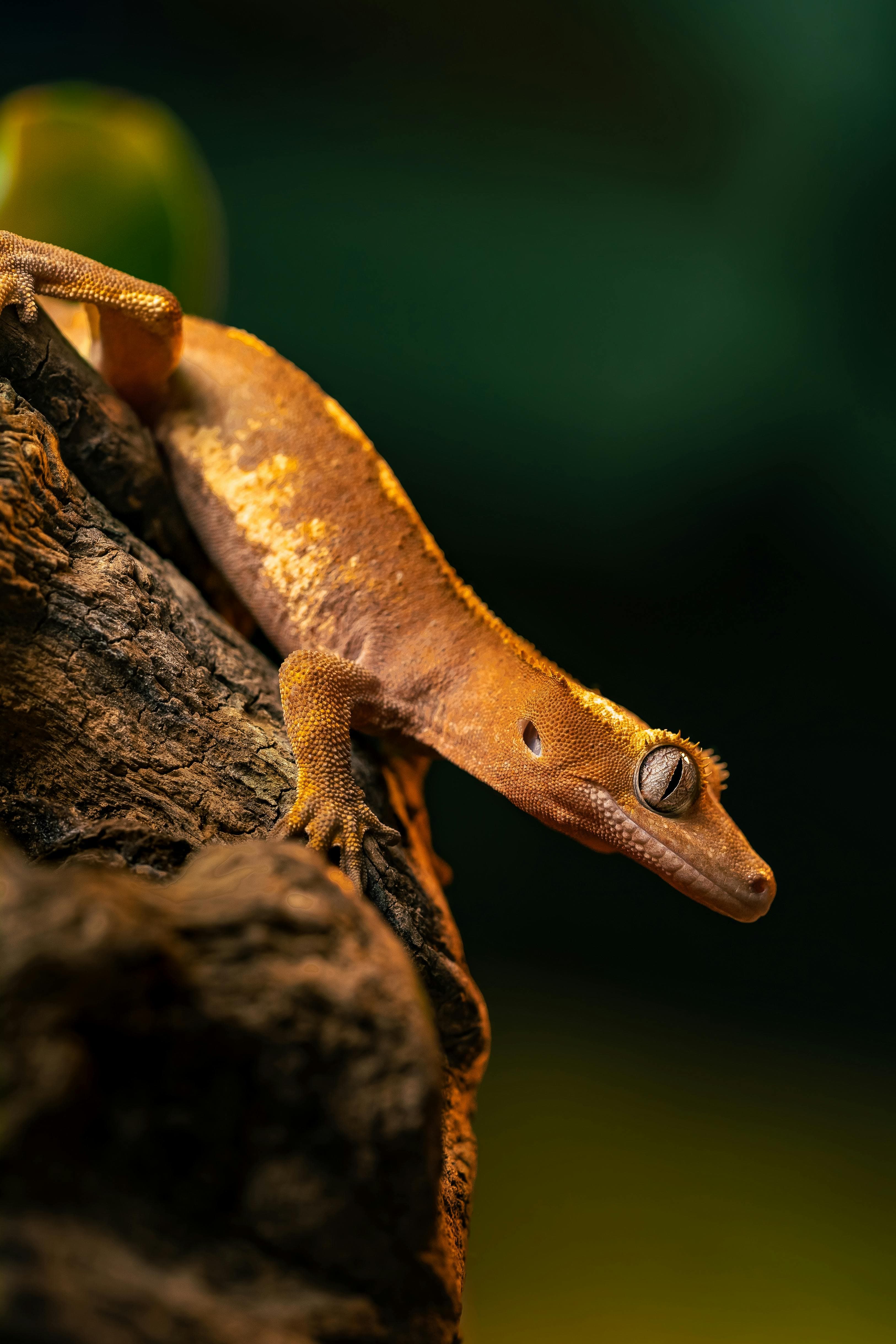
Morph guide
Crested Gecko Morph Guide
Correlophus ciliatus
This Crested Gecko morph guide covers all 33 known alleles, 36 named morphs, and 31 documented combo morphs. Alleles are organised by gene locus and dominance pattern. Tap any allele to expand its full trait description, identification tips, and homozygous risk warnings. This species has 3 alleles with known homozygous health risks, highlighted in the alleles list below.
Crested Gecko genetics calculator available
Predict offspring morph probabilities across multiple traits simultaneously
Axanthic
Allele notation
Removes yellow and red coloration, creating grey/black phenotypes. Recessive inheritance. Homozygous animals lack xanthophore pigments. Synergistic with Pinstripe to create strong paper-white pattern expression.
Black Base
Allele notation
Fixed dominant allele producing black/dark base coloration. Most prevalent in wild and captive populations. Produces normal dark crested gecko coloring when not modified by other traits. Creates Lavender combo morph when combined with Hypo.
Black Eyed Leucistic / Blizzard
Genetic code
Homozygous Fire morph (FI/FI) displaying a white body with yellow pigment retention and black eyes. Also called Super Fire or Blizzard. First produced April 2023 by The Bugg Plug. CAUTION: at least five independent lines produce a BEL (The Bugg Plug's Genetic Hypo, Reptiles by Mack's line, sold first as Pinky and then as Mack Hypo, GhostPax, a fourth US source, and one in South Korea). No cross between any two has been reported and none has been sequenced, so compatibility is unproven rather than established.
Bullseye
Thinly documented Dalmatian spot variation with a dark outer spot and an intense red center. Published inheritance accounts conflict, so no inheritance mode is assigned.
Cappuccino
Allele notation
Also shown as
Super Cappuccino
Produces lighter, coffee/tan coloration. Heterozygous animals show intermediate tan coloring and are healthy. Homozygous Super Cappuccino exhibit significant genetic health issues: reduced nostril size causing breathing difficulties, and poor overall thriving. Part of allelic complex with Sable. Breeding for Super Cappuccino is not recommended.
ChoCho
Allele notation
Simple recessive trait affecting red and tangerine pigment display and age-dependent colour change. ChoCho hatches maroon red, with every normally cream part of the animal covered in a tangerine layer of pigment, and darkens with age. Sources disagree about the adult endpoint. The breeder who requested the gene records it as not in complex with other genes, and names no related genes.
Cold Fusion
Allele notation
Refined Hypo line producing extremely light coloration with a soft blue hue in the base. The cream and yellow visible on these animals is pattern over the cool base rather than base color.
Dalmatian
Allele notation
Also shown as
Super Dalmatian
Adds distinct black/dark spots throughout the body and pattern. Dominant trait with additive effects in homozygous animals producing more/denser spotting. Creates a speckled or spotted appearance overlaid on existing patterns.
Empty Back
Allele notation
Also shown as
Super Empty Back
Reduces or eliminates dorsal/back pattern coloring while retaining pattern structure on sides. Heterozygous shows moderate pattern reduction on back; homozygous shows extensive back clearing. Antagonistic with Harlequin (overcomes concentration).
Fire
Allele notation
Also shown as
Black Eyed Leucistic / Blizzard
Incomplete dominant trait reducing melanin and dark pigmentation. Heterozygous animals show lighter, washed-out coloration compared with normals. Homozygous animals display a white body with yellow pigment retention and black eyes. At least five independent lines produce this phenotype. No cross between any two has been reported and none has been sequenced, so compatibility is unproven rather than established.
Flame
Allele notation
Creates flame-like pattern formations, possibly distinct from Harlequin flame-concentration. Appears to produce pointed flame shapes. Dominance pattern unclear. Polygenic inheritance suspected.
Furry
Allele notation
Produces enhanced scale texture creating "furry" appearance. Work in progress, inheritance pattern not yet confirmed. Limited breeding data. Polygenic inheritance suspected.
Harlequin
Allele notation
Also shown as
Super Harlequin
Concentrates dorsal pattern into flame-like or high-contrast patches. Heterozygous animals show intermediate pattern concentration; homozygous show maximum concentration and contrast. Interacts with Tiger to create visible pattern breaks and "portholes." Antagonistic with Empty Back.
Highway
Allele notation
Also shown as
Super Highway
Third allele in the Sable/Cappuccino allelic complex. Incomplete dominant trait affecting coloration and dorsal pattern expression. Highway x Cappuccino and Highway x Sable produce distinct compound heterozygote phenotypes.
Hypo
Allele notation
Reduces melanin and dark pigmentation, producing lighter base coloration. Dominant over melanin. Multiple forms exist, all dominant. Hypo acts as an epistatic modifier over Black Base, Red Base, and Yellow Base. Creates Lavender (H+B), Pink (H+r), and Cream/C2 (H+y) combo morphs.
Lilly White
Allele notation
Health risk
Super Lilly White (homozygous L/L) is LETHAL. Homozygous animals struggle to breathe, have trouble with motor skills, fail to eat, and usually die within days to one week. Likely due to extreme melanin reduction affecting crested gecko organ development and function. Melanin is found in organs of several species and may facilitate organ development. This is the ONLY confirmed lethal homozygous condition in crested geckos. DO NOT breed Lilly White x Lilly White. Documented consistently across multiple breeding programs. Source: Foundation Genetics Part 2.1.
Produces white/cream coloration with pattern reduced or eliminated. Heterozygous animals show white coloring with some pattern retention. Homozygous Super Lilly White (L/L) is LETHAL and must NEVER be attempted. All breeding must use het x het or het x normal.
Marble
Allele notation
Creates marble-like pattern formations. May be a Tiger variant or distinct pattern modifier. Limited data available. Polygenic inheritance suspected. Research ongoing.
Marbling
Allele notation
Produces concentrated solid white pattern in many sizes at once, ranging from large solid orbs and mottled bands to single flecks. Unlike soft Snowflake patterning, Marbling brings its own white and does not depend on White Pattern or Lilly White.
Normal / Wild Type
Wild-type crested gecko. No specific morph alleles expressed. Base coloration ranges from brown to olive with variable pattern. Most common phenotype in wild and established captive populations.
Oil Spot
Dalmatian spot variation made of incompletely developed black spots that read grey-olive and change with firing state. Its inheritance is not established.
Orange Pattern
Allele notation
Secondary form of pattern color expression producing orange/yellow pattern lines and spots. Polygenic inheritance. Creates Halloween (B + OP) and Tri-Color (WP + OP) combo morphs.
Orange Spot
Allele notation
Creates orange/yellow spotting and marking patterns. Appears distinct from Orange Pattern. Dominance unclear. Polygenic inheritance suspected. Early stage research.
Patternless
Allele notation
Complete removal of pattern elements. Distinct from Phantom (which is a melanin-producing trait); Patternless removes pattern structure entirely. Homozygous animals are completely unicolor with no pattern lines, spots, or flames.
Phantom
Allele notation
Melanin-producing trait that creates various phenotypes including bi-color, patternless, buckskin, cream, and tan appearances. Blends melanin with base colors, particularly visible on yellow-based animals. Expression ranges from high expression (strong bi-color, patternless) to low expression (subtle melanin blending). Affects pattern expression and can suppress white pattern on raised scalation. Key finding: bi-color, patternless, buckskin, cream, and tan are NOT separate traits. They are all phenotypic expressions of the single Phantom trait.
Pinstripe
Allele notation
Raised scales along dorsal midline creating a distinct ridge or stripe. Dominant expression creates visible raised scalation. Interacts with Tiger to create brindle and reverse pin phenotypes. Homozygous expression more pronounced than heterozygous.
Pixel
Allele notation
Recessive pattern disruptor that scatters white and orange pattern into pixels or static. It changes pattern distribution rather than Dalmatian spotting and is not known to alter pinning.
Quadstripe
Allele notation
Simple dominant pattern trait inherited separately from Pinstripe. Quadstripe is visible only when Pinstripe is also present.
Red Base
Allele notation
Produces red/orange base coloration when homozygous. Recessive inheritance. Heterozygous animals may show blush (pink/red coloration on cheeks) as a reliable het marker. Blush is one of the few confirmed het markers in crested geckos. Creates Pink combo morph when combined with Hypo.
Red Spot
Dalmatian spotting in which red spots outnumber black spots. Red Spot describes the visible spot-color ratio; its inheritance is not established.
Sable
Allele notation
Also shown as
Super Sable
Produces darker, more saturated coloration. Heterozygous animals show intermediate expression; homozygous express full Sable phenotype. Part of allelic complex with Cappuccino at the same locus. Sable x Cappuccino crosses did NOT produce Super Cappuccino, proving these are separate alleles despite occupying the same gene locus.
Snowflake
Allele notation
Creates white spotting/flecking pattern in snowflake-like formations. Epistatic to White Pattern. Snowflake requires WP to express. Heterozygous shows moderate snowflake spotting; homozygous shows enhanced spotting. Synergistic with Lilly White to produce near-full white coverage.
Softscale
Allele notation
Also shown as
Super Softscale
Produces matte coloration and smooth scale appearance. Heterozygous shows moderate matte effect; homozygous Super Softscale shows enhanced matte and scale spacing effects. Structural modification affecting appearance and potentially tactile properties.
Super Cappuccino
Genetic code
Homozygous Cappuccino morph. Visually striking. Often jet-black, monochrome, or translucent with solid black eyes. Associated with significant health concerns: reduced nostril size, breathing difficulties, and poor thriving. Breeding to produce Super Cappuccino is not recommended. Lower incubation temps (69-71°F) reduce but do not eliminate structural issues.
Super Dalmatian
Genetic code
Heavy black spotting
Super Empty Back
Genetic code
Homozygous Empty Back morph showing extensive back pattern clearing. Radical reduction of dorsal pattern coloring.
Super Harlequin
Genetic code
Homozygous Harlequin morph (HQ/HQ) displaying maximum flame/pattern concentration. Extreme pattern coverage approaching 80%+ of body. Pattern connects dorsal to lateral regions and can form full saddles. Also called Extreme Harlequin. NOTE: "XXX" is a marketing descriptor coined by Matt Parks (Pangea Reptile) for phenotypically extreme Harlequin animals, not a genetic designation. XXX animals are not necessarily proven homozygous. Source: ReptiDex (reptidex.com), LM Reptiles (lmreptiles.com/fg-pt2-1/), Pangea Reptile (pangeareptile.com), MorphMarket Morphpedia (morphmarket.com/morphpedia/crested-geckos/extreme-harlequin/).
Super Highway
Genetic code
Homozygous Highway morph (HWY/HWY) displaying unique super form phenotype. NOTE: Super Highway has documented health complications. Breeders report issues in homozygous animals similar to other allelic complex supers. Use caution in pairing planning. Source: Omni Geckos (omnigeckos.com/highway/).
Super Sable
Genetic code
Homozygous Sable morph expressing full dark saturation. Extremely dark, nearly melanistic coloration. Result of pairing two Sable-carrying parents.
Super Softscale
Genetic code
Homozygous Softscale morph showing enhanced matte coloration and pronounced scale spacing. More extreme texture than het form.
Superstripe
Allele notation
A pattern trait, not a structural one. The pattern widens inward from the pin rows toward the spine, from barely spilling over them to nearly meeting in the middle. It is carried on a pinstriped animal, so any raised scalation belongs to Pinstripe rather than to Superstripe.
Tangerine
Allele notation
Adds orange, peach, or pink pigment to pattern only without changing the base color. Heterozygous animals show Tangerine expression; homozygous animals show stronger Super Tangerine (Hyper) expression. Synergistic with White Pattern to create pink or bubblegum patterns.
Tiger
Allele notation
Fixed dominant trait present in ALL crested geckos; it cannot be isolated from the species. Controls pattern separation and distribution into distinct spots/flames. Similar to spots on leopard geckos or alien heads on ball pythons. Ratio of Tiger to other pattern traits determines expression from brindle to reverse pin to solid.
White Pattern
Allele notation
Primary form of pattern color expression (as opposed to Orange Pattern). Creates white/cream pattern lines and spots. Polygenic inheritance. Base for Snowflake expression (epistatic relationship). Modified by Tangerine to create pink/bubblegum patterns.
Whiteout
Genetic code
Heterozygous Whitewall morph showing moderate lateral white/cream coloration. Whitening along sides and body edges.
Whitewall
Allele notation
Also shown as
Whiteout
Creates cream/white coloration along lateral (side) edges and body perimeter. Heterozygous shows moderate lateral white; homozygous (Whitewall) shows extensive lateral white, potentially approaching unicolor appearance. Extreme expression of white pattern laterally.
Yellow Base
Allele notation
Produces yellow/light base coloration. Naturally hypo-melanistic. Dominant or co-dominant expression. Creates Creamsicle (y + optional H/TANG) and C2/Cream Squared (y + H) combo morphs. Yellow-based animals with melanin blending indicate Phantom trait.
Related guides
Next steps
- Open the genetics calculatorPredict offspring morph probabilities across every trait at once.
- Identify a morph from a photoUpload a photo for AI-assisted trait suggestions with confidence scores.
- Build a pedigreeGenerate multi-generation pedigrees your buyers can trust.
- Import your spreadsheetBring an existing collection into ReptiDex from a spreadsheet.
- See how records follow the animalEvery record you keep travels with the animal when it changes hands.
Manage your crested gecko breeding project
Track lilly whites, pinstripes, and every combo in your collection. ReptiDex keeps genetic records, pairing history, and clutch outcomes in one place.
Get Started Free