Axanthic, Phantom & Patternless: Recessive Traits Deep Dive
Part of the Crested Gecko Genetics Series. Last updated March 2026.
Recessive traits are the long game. You can't see them in carriers, they require both parents to contribute a copy for visual offspring, and proving hets takes patience and breeding trials. But the results are some of the most striking animals in the hobby: true grayscale Axanthics, the endlessly misunderstood Phantom, and the clean simplicity of Patternless. This post covers all three in depth.
For genetics fundamentals (what "recessive" and "het" mean), see Genetics Basics Explained.
Understanding Recessive Traits
Critical Concept: Recessive traits require TWO copies to be visible. One copy = invisible carrier ("het").
Why This Matters:
- Cannot tell by looking if gecko is het
- Genes can hide for generations
- Must rely on documentation and breeding trials
- Proving hets takes years
- No lethal combinations known (unlike Lilly White)
Axanthic (x) - Recessive, True Grayscale
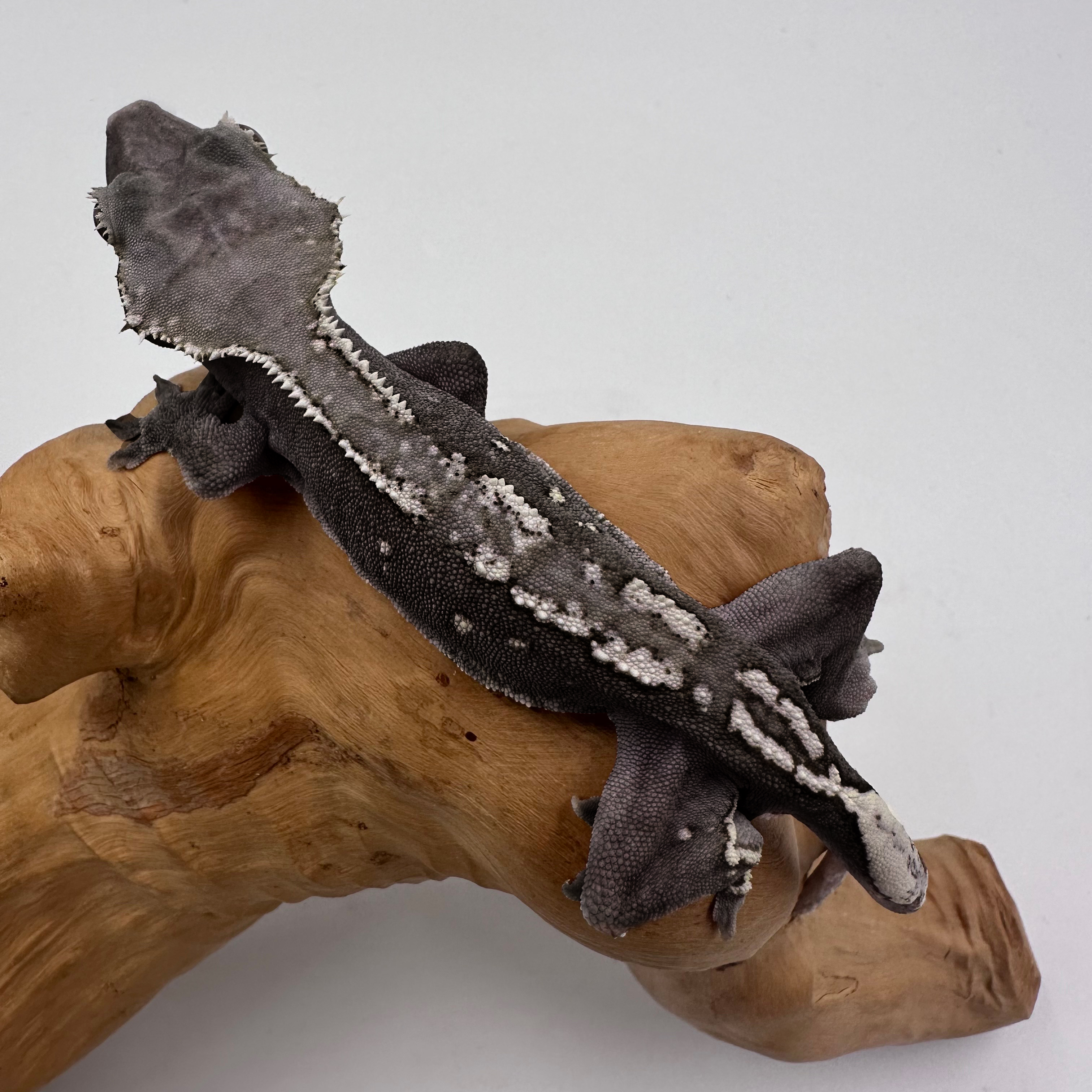
What It Is
A recessive morph that eliminates yellow and red pigmentation (xanthophores and erythrophores), producing true grayscale geckos in stunning black, white, and gray tones.
The only morph that creates TRUE grayscale appearance.
Genetics Deep Dive
Inheritance: Recessive (simple Mendelian recessive)
Category: COLOR_MODIFIER
Locus Code: x
Visual Expression: Requires TWO copies of the gene (x/x)
The Science:
Axanthic geckos lack functional pigment cells:
- NO xanthophores (yellow pigment cells) - completely absent or non-functional
- NO erythrophores (red pigment cells) - completely absent or non-functional
What remains:
- Melanophores (black/brown pigment cells) - functional
- Iridophores (white/reflective cells) - functional
Result: True grayscale appearance,only black, white, and grey.
Expression:
- Two copies (x/x): Visual Axanthic. True grayscale ✓
- One copy (+/x): Het Axanthic. Appears COMPLETELY NORMAL (carrier)
- No copies (+/+): Normal (non-carrier)
Visual Characteristics
Visual Axanthic (x/x):
- True grayscale - blacks, whites, and grays ONLY
- NO yellow pigmentation anywhere on body
- NO red pigmentation anywhere on body
- Pattern still visible in black and white (not "patternless")
- Dramatic appearance unlike any other morph
- Consistent throughout life - doesn't "fire up" to color
- Can combine with patterns:
- Axanthic Harlequin - grayscale with Harlequin pattern
- Axanthic Pinstripe - grayscale with white pins
- Axanthic Dalmatian - grayscale with black spots
- Axanthic Phantom - grayscale with Phantom modifications
What Axanthic Looks Like:
- Base: Black, grey, or white (no color)
- Pattern: White or light grey against dark grey/black
- Spots (if Dalmatian): Black spots on grey
- Pins (if Pinstripe): White/cream pins on grey
- Eyes: Typically dark
- Overall: Monochromatic, like a black and white photograph
Het Axanthic (+/x):
- Looks 100% COMPLETELY NORMAL
- Indistinguishable from non-carriers visually
- Carries one copy of gene
- Can produce visual Axanthic offspring when bred appropriately
- NO visual indicators of carrying the gene
- Cannot be identified by appearance alone
The "Het" Problem - Why Axanthic Is Challenging
Critical Issue: Het Axanthic geckos look 100% COMPLETELY NORMAL.
This means:
- CANNOT tell by looking if a gecko is het
- Must trust breeder documentation completely
- Must keep meticulous breeding records
- Must prove het status through breeding trials (takes years)
- Gene can "hide" in lines for generations unseen
- Never assume a gecko is het without proof or documentation
Proving Het Status:
To CONFIRM a gecko is Het Axanthic:
Step 1: Breed claimed het to a Visual Axanthic (x/x)
Step 2: Wait for results (6-18+ months)
Step 3: Interpret outcomes:
If ACTUALLY het (+/x):
| Het Axanthic (+/x) × Visual Axanthic (x/x) | Axanthic (x) | Axanthic (x) |
|---|---|---|
| Normal (+) | +/x | +/x |
| Axanthic (x) | x/x ✓ PROOF | x/x ✓ PROOF |
Outcomes: 50% Het (look normal), 50% Visual (grayscale) ✓ PROVES het status
- Expect: 50% of babies are visual Axanthic (grayscale)
- This proves parent is het ✓
If NOT het (+/+):
| NOT Het (+/+) × Visual Axanthic (x/x) | Axanthic (x) | Axanthic (x) |
|---|---|---|
| Normal (+) | +/x | +/x |
| Normal (+) | +/x | +/x |
Outcomes: 100% Het (all look normal), 0% Visual - NOT het
- Expect: NO visual Axanthic babies (all look normal)
- After reasonable sample (15-20 eggs), likely NOT het
Time Investment:
Proving het status takes 2-3 years MINIMUM:
- Breeding age maturity: 18-24+ months
- Breeding season: Wait for spring/summer
- Egg laying: 30-60 days after pairing
- Incubation period: 60-90 days
- Hatching: Immediate visual confirmation (grayscale or not)
- May need multiple clutches for statistical confidence
Market Impact:
- "Proven Het" = higher value (breeding trials confirm)
- "Possible Het" or "Unproven Het" = lower value (no proof, just claim)
- Visual Axanthic = highest value (guaranteed genetics, no guessing)
Breeding Axanthic
Genetic Notation:
- x/x = Visual Axanthic (homozygous recessive)
- +/x = Het Axanthic (heterozygous carrier, looks normal)
- +/+ = Normal (no Axanthic gene)
Visual Axanthic (x/x) × Normal non-carrier (+/+):
| Visual Axanthic (x/x) × Normal (+/+) | Normal (+) | Normal (+) |
|---|---|---|
| Axanthic (x) | +/x | +/x |
| Axanthic (x) | +/x | +/x |
Outcomes: 100% Het Axanthic (+/x) - all look normal
- 100% Het Axanthic (+/x)
- All offspring LOOK NORMAL but carry gene
- All can produce Axanthic if bred to carrier or visual
- Useful for building het lines
Visual Axanthic (x/x) × Het Axanthic (+/x):
| Visual Axanthic (x/x) × Het Axanthic (+/x) | Normal (+) | Axanthic (x) |
|---|---|---|
| Axanthic (x) | +/x | x/x |
| Axanthic (x) | +/x | x/x |
Outcomes: 50% Het Axanthic (+/x), 50% Visual Axanthic (x/x) ✓ PROOF
- 50% Het Axanthic (+/x) - look normal, carry gene
- 50% Visual Axanthic (x/x) - grayscale ✓
- Best pairing for PROVING hets
- Produces visual Axanthics at 50% rate
Visual Axanthic (x/x) × Visual Axanthic (x/x):
| Visual Axanthic (x/x) × Visual Axanthic (x/x) | Axanthic (x) | Axanthic (x) |
|---|---|---|
| Axanthic (x) | x/x | x/x |
| Axanthic (x) | x/x | x/x |
Outcomes: 100% Visual Axanthic (x/x)
- 100% Visual Axanthic (x/x)
- All offspring grayscale
- Guaranteed outcome
- Useful for building pure Axanthic lines
Het Axanthic (+/x) × Het Axanthic (+/x):
| Het Axanthic (+/x) × Het Axanthic (+/x) | Normal (+) | Axanthic (x) |
|---|---|---|
| Normal (+) | +/+ | +/x |
| Axanthic (x) | +/x | x/x |
Outcomes: 25% Normal (+/+), 50% Het Axanthic (+/x), 25% Visual Axanthic (x/x)
- 25% Normal (+/+) - non-carriers
- 50% Het Axanthic (+/x) - carriers, look normal
- 25% Visual Axanthic (x/x) - grayscale ✓
- Classic Mendelian recessive ratios
- Cannot tell hets from normals visually
Challenge: 75% of offspring look normal, but only 2/3 of those are actually het.
Common Axanthic Combinations
Axanthic can combine with ANY pattern or trait:
Axanthic Harlequin:
- Grayscale with Harlequin pattern
- Black and white contrast
- Pattern still visible in monochrome
- Very striking
Axanthic Pinstripe:
- Grayscale with white/cream pins
- Clean monochromatic appearance
- Pins stand out against grey
- Highly desirable
Axanthic Dalmatian:
- Grayscale with black spots
- Spots on grey/white base
- Unique polka-dot appearance
- Every individual different
Axanthic Phantom:
- Grayscale with Phantom pattern modification
- Melanin blending in grey tones
- Subtle pattern effects
- Rare combination
Axanthic + ANY pattern:
- Pattern remains visible
- Expressed in black/white/grey
- No color distraction
- Pure pattern appreciation
All combinations remain true grayscale (no yellow/red returns).
Market Value
Visual Axanthic: $1000-$5000+ (very rare, dramatic appearance, guaranteed genetics)
Het Axanthic (proven through breeding): $200-$800 (value in breeding projects)
Het Axanthic (unproven/possible): $100-$300 (speculation, no proof)
Why Visual Axanthic Is So Expensive:
Rarity:
- True recessive trait (harder to produce than dominant/incomplete dominant)
- Both parents must carry gene
- Only 25% from het × het pairings
- Takes years to establish lines
Appearance:
- Dramatically unique (only grayscale morph)
- Cannot be "faked" (either grayscale or not)
- Stands out completely from all other morphs
- No other morph looks similar
Breeding:
- Limited availability (fewer breeders working with it)
- Breeding projects take y...