Morph guide
Bearded Dragon Morph Guide
Pogona vitticeps
This Bearded Dragon morph guide covers all 7 known alleles, 14 named morphs, and 7 documented combo morphs. Alleles are organised by gene locus and dominance pattern. Tap any allele to expand its full trait description, identification tips, and homozygous risk warnings. This species has 1 allele with known homozygous health risks, highlighted in the alleles list below.
Bearded Dragon genetics calculator available
Predict offspring morph probabilities across multiple traits simultaneously
Citrus
Genetic code
Yellow/orange color line
Dunner
Allele notation
Dunner is a dominant mutation named after Kevin Dunn, the breeder who first produced this morph. Dunner modifies both scale direction and body pattern. In normal bearded dragons, scales lie flat and point posteriorly (toward the tail) in consistent rows. Dunner disrupts this organization: scales point outward and in random directions, giving the body a more chaotic or "bristled" texture when touched. Running a hand across a Dunner dragon feels different from a normal (resistance from redirected scales rather than smooth passage). Pattern-wise, the typical orderly lateral spot rows of normal bearded dragons are disrupted: markings appear more randomly placed, scattered, or absent from their usual positions. The tail shows distinctive modified scalation compared to a normal. Dunner also affects the undersides of the toes, which show modified scale direction visible on close inspection. As a dominant trait, one copy of the Dunner gene produces the full visual phenotype in heterozygous animals (50% of offspring from Dunner × non-Dunner pairings show the trait). Note: Homozygous "Super Dunner" animals have been produced. Some breeders report enhanced expression relative to heterozygous Dunner, which may indicate incomplete dominance rather than simple dominance.
German Giant
Allele notation
German Giant is a polygenic (line-bred) size trait that produces significantly larger than average bearded dragons through selective breeding. Standard adult Pogona vitticeps reach 40-60cm (16-24 inches) total length and 400-600g. German Giant specimens from established oversized lines can reach 65-80cm (26-32 inches) or more and 700-1000g+. Like other polygenic/line-bred traits, German Giant is controlled by multiple genes that each contribute additive effects to adult size. There is no simple Mendelian inheritance ratio. Crossing a German Giant to a standard-sized animal produces offspring of intermediate size, and maximum size is achieved only by continued selection pressure across multiple generations (selecting the largest offspring for breeding). Because German Giant is polygenic, size advantage degrades significantly when crossed with non-Giant animals, requiring active size selection to maintain in a line. IMPORTANT CAVEAT: German Giant is frequently mislabeled in the commercial market. Many animals sold or described as "German Giant" are large-normal individuals rather than animals from documented oversized lines. True German Giant lineage should be supported by size documentation across multiple generations from established programs.
Hypo
Genetic code
Homozygous recessive at the Hypo (Hypomelanistic) locus (hypo/hypo). Reduced melanin production results in brighter, more vivid coloration compared to normal bearded dragons. Most reliable diagnostic: clear or translucent nails (normal nails are dark and opaque). Body coloration is cleaner and more saturated. Reds, oranges, and yellows appear vivid without the heavy dark melanin overlay that mutes normal bearded dragon colors. Patterning is present but rendered in lighter, less intense browns rather than deep blacks. One of the most foundational and commercially prevalent bearded dragon morphs; the majority of captive-bred fancy dragons carry at least one Hypo allele. Hypo does not alter pattern structure, scale morphology, or eye color. It is a pure melanin intensity modifier.
Hypo (Hypomelanistic)
Allele notation
Also shown as
Hypo
The Hypo (Hypomelanistic) locus is a recessive mutation that reduces melanin (dark pigment) production in bearded dragons. Homozygous Hypo animals (hypo/hypo) display brighter, more vivid coloration because the dark pigment that would otherwise mask or mute their base colors is reduced. Reds, oranges, and yellows appear more saturated. Nails are clear or nearly clear rather than dark and opaque. This is the most reliable visual diagnostic marker. Patterning is present but rendered in a reduced-intensity form without the heavy dark pigment overlay of normal animals. Hypo is one of the foundational morphs in bearded dragon keeping and is present in the vast majority of captive-bred "fancy" bearded dragons. Heterozygous carriers (het Hypo) appear visually similar to normals and cannot be reliably identified by eye; confirmation requires genetic testing or breeding trials. Hypo does not alter pattern structure, scale morphology, or eye color. It is purely a melanin intensity modifier.
Hypomelanistic
Genetic code
Reduced black pigment
Leatherback
Allele notation
The Leatherback locus is an incomplete dominant mutation affecting scale size and texture. Three phenotypically distinct forms exist based on zygosity, confirming incomplete dominant (not simple dominant) inheritance:
- 1Normal (lb/lb): Full-sized, prominent, spiked scales arranged in rows; the typical rough, spiked bearded dragon appearance.
- 2Leatherback (Lb/lb, heterozygous): Reduced scale size across the dorsal and lateral body, producing a smoother texture. Lateral spike rows are reduced or absent. Body appears sleeker than normal. Colors appear more vivid because fewer and smaller scales diffuse light. The commercially popular "Leatherback" phenotype.
- 3
Silkback / Super Leatherback (Lb/Lb, homozygous): NO scales whatsoever. The entire body is smooth bare skin. Similar to an unscaled snake shed. Coloration appears extremely vivid because no scales refract or obscure pigment.
CRITICAL HEALTH WARNING: Silkback animals have chronic, severe welfare concerns thoroughly documented in the bearded dragon community and by reptile veterinary professionals. See homozygous_risk documentation. The hobby incorrectly terms this trait "co-dominant"; the correct genetics classification is "incomplete dominant" because the three phenotypes (Normal, Leatherback, Silkback) are distinguishable.
Normal
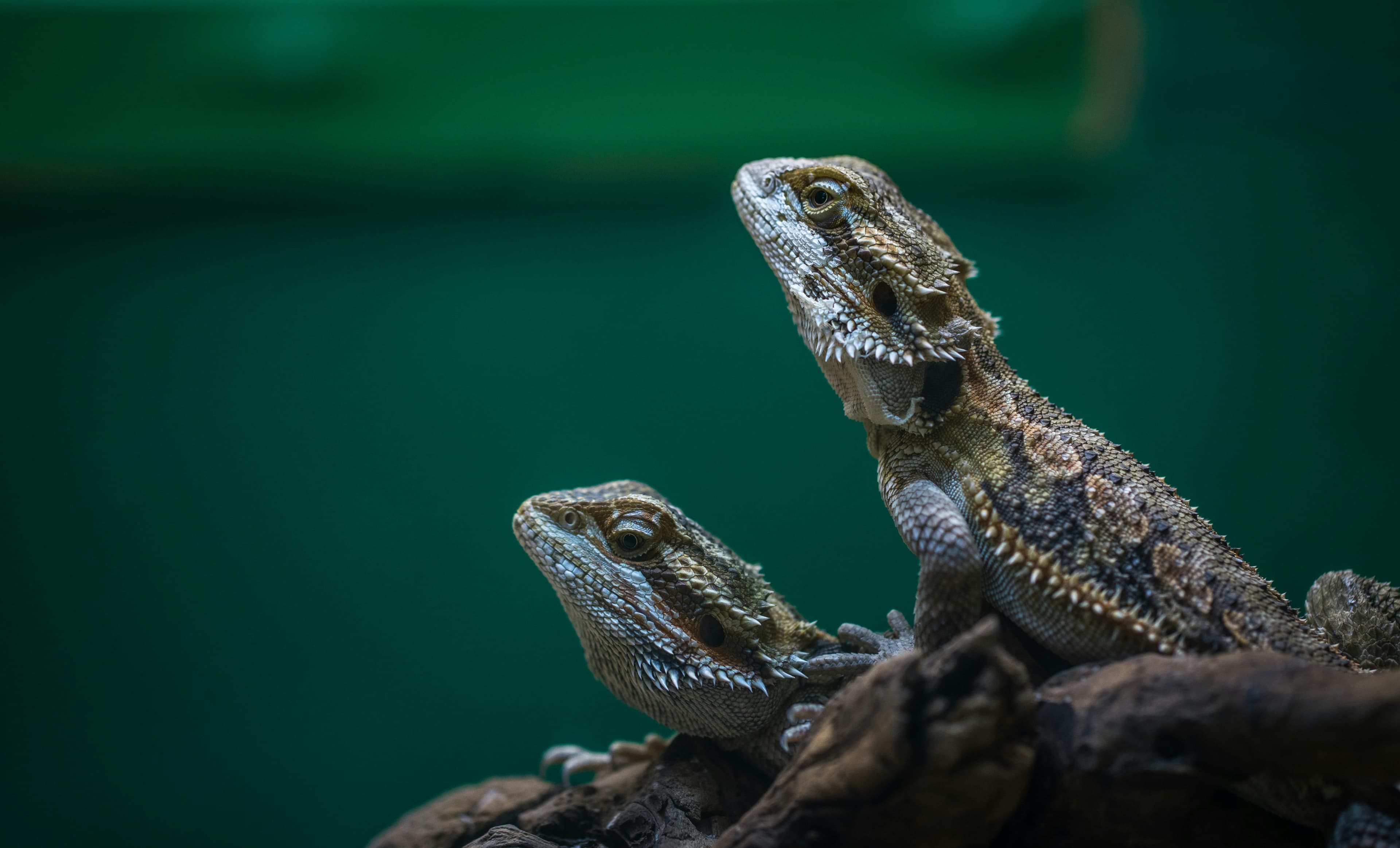
The wild-type Pogona vitticeps phenotype. Typically tan to brown body with lighter lateral stripes and rows of darker brown to black spots. Prominent gular (beard) pouch that darkens dramatically when the animal is threatened or displaying. Rows of lateral spikes along the body sides. Distinctive triangular, flattened head profile. Coloration varies significantly by individual, temperature, and mood. Animals can lighten and darken dynamically. Belly is pale cream to white. Wild-type coloration evolved for camouflage in the semi-arid scrublands and arid woodlands of eastern and central Australia. Genotype: wild type at all loci.
Orange
Genetic code
Orange color enhancement
Red
Genetic code
Red color enhancement
Silkback
Genetic code
Homozygous Leatherback (super form); completely scaleless. Requires special husbandry due to delicate skin
Translucent
Allele notation
The Translucent locus is a recessive mutation affecting both scale structure and pigmentation. Homozygous Translucent animals (trans/trans) have semi-transparent scales that appear to have a blue, purple, or dark tinge, particularly visible on the belly, sides, and limbs. The most diagnostically reliable and consistently expressed feature is the eyes: Translucent bearded dragons have solid, uniformly dark eyes, often described as "black eyes" or "solid eyes", with no visible iris patterning or gradients. This solid eye trait is present from hatching and persists throughout the animal's life. Scale appearance has a slightly glassy or gelatinous quality compared to the matte, rough texture of normal scales. Belly coloration is commonly darker than normal, often with a blue-gray or purplish cast. Hatchlings frequently display a pronounced dark or blue-black coloration ("blue baby" phase) that lightens with age, though the solid eye always remains. The Translucent trait does not affect scale count, scale size, or body structure. Scale morphology remains normal. Heterozygous carriers appear phenotypically normal with standard scales and normal eye color; reliable identification requires genetic testing or breeding trials.
Witblits
Allele notation
Witblits is a recessive mutation producing a patternless phenotype with muted, earthy coloration. The word "Witblits" is Afrikaans for "white lightning," reflecting its South African origin. One of the few bearded dragon morphs with documented non-US/non-European origins. Homozygous Witblits animals (wit/wit) lack the typical bearded dragon pattern of spots, blotches, and lateral stripes. The body appears uniformly colored without distinct pattern elements. Coloration tends toward earthy, muted tones: cream, tan, pale brown, light gray, or pale yellow, without vivid color expression. Unlike the Zero morph (which is also patternless and tends toward white/silver/pale near-colorless), Witblits retains some warm pigmentation rather than being depigmented. Witblits animals still produce pigment; the mutation eliminates pattern rather than depigmenting the animal. Scale morphology and eye color are normal (not solid dark like Translucent; not smooth like Leatherback). Witblits and Zero are separate, non-allelic loci confirmed by complementation testing. Heterozygous carriers appear phenotypically normal.
Yellow
Genetic code
Yellow color enhancement
Zero
Allele notation
Zero is a recessive mutation producing a patternless, near-colorless phenotype. The most extreme of the patternless mutations in bearded dragons. Homozygous Zero animals (zero/zero) lack all pattern and most pigmentation, resulting in animals that appear white, silver, pale gray, or very light with a clean, uniform appearance. Zero removes both pattern AND most color expression, whereas Witblits (also patternless) removes pattern but retains muted earthy pigmentation. Zero animals often appear strikingly pale and "icy". Particularly those also carrying Hypo genetics, which can produce near-white, vivid animals. Scale morphology and eye color are normal (eyes not solid dark like Translucent; scales not smooth like Leatherback; nails not clear like Hypo unless also Hypo). Witblits and Zero are at separate, non-allelic loci confirmed by complementation testing. When homozygous at both loci simultaneously, the Wero combo morph results. Zero has approximately 1,900 monthly searches (DataForSEO, US, March 2026), making it one of the highest-demand bearded dragon morph search terms. Heterozygous carriers (het Zero) appear phenotypically normal.
Related guides
Next steps
- Open the genetics calculatorPredict offspring morph probabilities across every trait at once.
- Build a pedigreeGenerate multi-generation pedigrees your buyers can trust.
- Import your spreadsheetBring an existing collection into ReptiDex from a spreadsheet.
- See how records follow the animalEvery record you keep travels with the animal when it changes hands.
Track bearded dragon morphs with ReptiDex
Leatherbacks, hypos, zeroes, and more. Keep clear genetic and breeding records so every hatchling comes with full documentation.
Get Started Free