Morph guide
Axolotl Morph Guide
Ambystoma mexicanum
This Axolotl morph guide covers all 6 known alleles, 8 named morphs, and 6 documented combo morphs. Alleles are organised by gene locus and dominance pattern. Tap any allele to expand its full trait description, identification tips, and homozygous risk warnings.
Axolotl genetics calculator available
Predict offspring morph probabilities across multiple traits simultaneously
Albino (Amelanistic)
Allele notation
Also shown as
Golden Albino
The Albino locus controls melanin synthesis via the tyrosinase enzyme. Homozygous recessive (a/a) animals completely lack the ability to synthesize melanin, eliminating all melanophore pigmentation. Xanthophores and iridophores remain functional, so an otherwise wild-type albino (D/- a/a) appears golden yellow with iridescent speckling and pink/red eyes. The "Golden Albino" phenotype. When combined with leucistic (d/d a/a), the result is the "White Albino". A white animal with pink/red eyes and no dark pigment or freckling.
Axanthic
Allele notation
The Axanthic locus controls xanthophore function. Homozygous recessive (ax/ax) animals have xanthophores that are unable to produce pteridines (yellow pigment), though the xanthophores themselves are still present and can store small amounts of dietary yellow pigments. The result is a gray to silver animal with dark melanophores and iridophores but little to no yellow coloration. Axanthic axolotls can appear similar to dark wild types, especially melanoid axanthics, making genotype confirmation from parents important.
Copper
Allele notation
The Copper locus controls eumelanin maturation via the Tyrp1 enzyme. Homozygous recessive (cu/cu) animals cannot fully oxidize eumelanin, producing pheomelanin (brown/red pigment) instead of eumelanin (black pigment). The result is a warm brown to copper-colored body with lighter eyes, functional xanthophores (yellow), and iridophores (iridescent). Copper axolotls are sometimes described as a form of tyrosinase-positive albinism because melanin synthesis initiates but cannot complete the full pathway to eumelanin.
Dark / White (Leucistic)
Allele notation
Also shown as
Leucistic
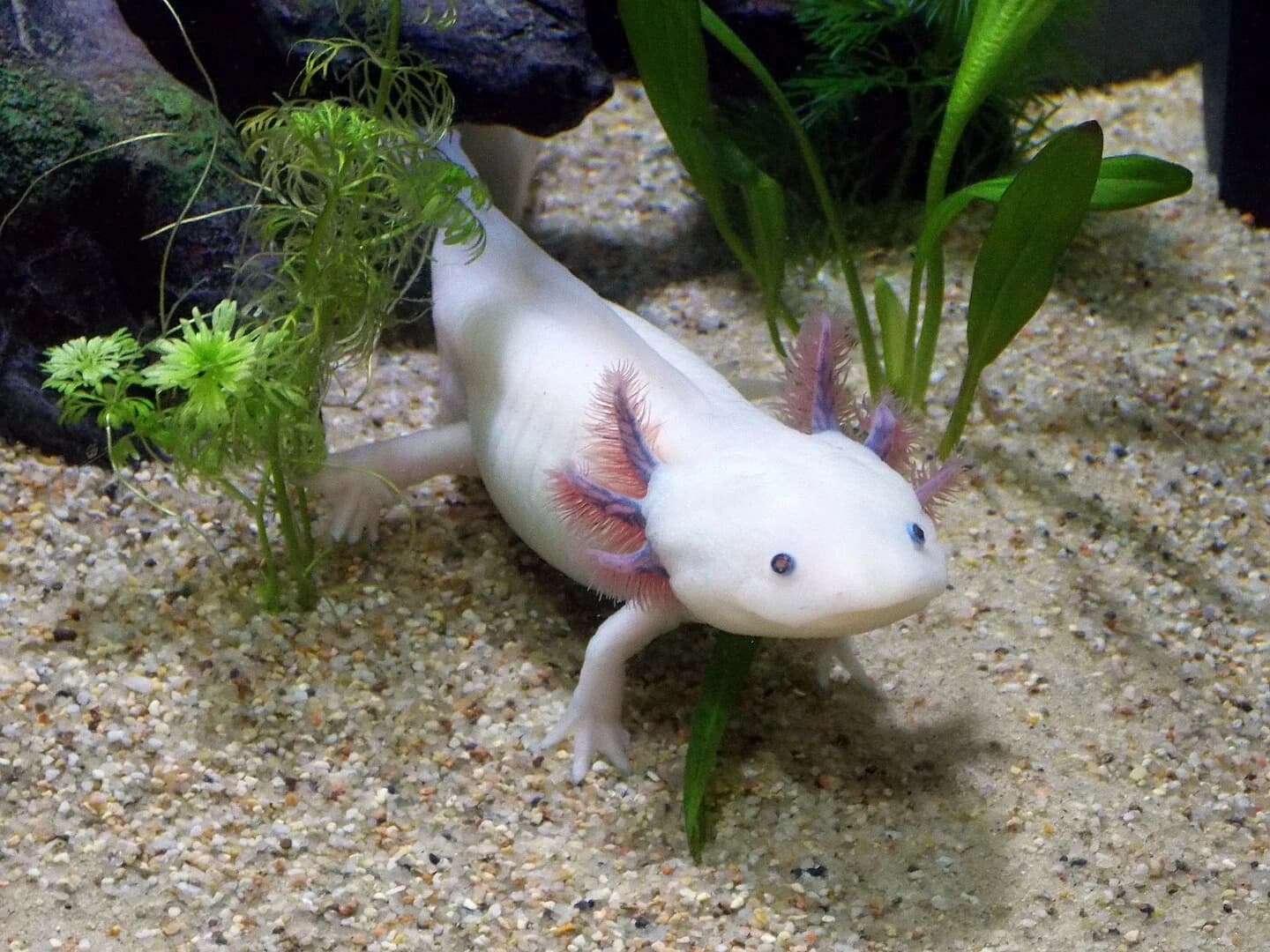
The Dark locus controls melanophore migration and differentiation during embryonic development. Wild type (D/-) allows normal melanophore distribution across the body. Homozygous recessive (d/d) results in the leucistic phenotype: melanophores fail to migrate from the neural crest into the skin, producing a white or pale pink animal with dark eyes. Leucistic axolotls retain the ability to synthesize melanin (unlike albinos) and commonly develop scattered dark freckles or patches on the head, gills, and dorsal crest as they mature. The d/d phenotype is the most popular and recognizable axolotl color morph in the pet trade.
GFP
Genetic code
Carries the Green Fluorescent Protein transgene (GFP+). Under normal visible light, GFP axolotls appear identical to their non-GFP counterparts of the same base morph. Under blue or ultraviolet light, GFP-expressing tissues fluoresce bright green, with gills and eyes often showing the most intense fluorescence. GFP is dominant. One copy produces visible fluorescence. Can be combined with any base color morph. GFP on a leucistic or albino base is the most visually dramatic combination because the green fluorescence contrasts strongly against the pale body. Note: GFP is a transgene of laboratory origin (Aequorea victoria jellyfish), not a natural axolotl mutation.
GFP (Green Fluorescent Protein)
Allele notation
Also shown as
GFP
Green Fluorescent Protein transgene. GFP-positive axolotls express a fluorescent protein originally derived from the jellyfish Aequorea victoria. Under normal visible light, GFP axolotls appear identical to their non-GFP counterparts. Under blue or ultraviolet light, GFP-expressing tissues fluoresce bright green. The transgene segregates as a dominant trait: one copy (hemizygous/heterozygous) produces visible fluorescence. GFP can be combined with any base color morph. The fluorescence is visible in all chromatophore backgrounds, though it is most dramatic in lighter morphs (leucistic, albino) where the green glow contrasts against the pale body.
Golden Albino
Genetic code
Homozygous recessive at the Albino locus (a/a) with wild type Dark locus (D/-). Melanin synthesis is completely abolished, but xanthophores (yellow) and iridophores (iridescent) remain fully functional. The result is a bright golden yellow body with iridescent speckling and pink to red eyes. External gills are bright pink-red. One of the most visually striking axolotl morphs. Distinguished from White Albino by the presence of visible yellow pigmentation (xanthophores visible against the non-leucistic background). Genotype: D/- a/a M/- Ax/- Cu/-.
Leucistic
Genetic code
Homozygous recessive at the Dark locus (d/d). White to pale pink body with dark (black) eyes. The signature feature distinguishing leucistic from albino. Melanophores fail to migrate into the skin during development but melanin synthesis is intact, so eyes retain dark pigmentation. Many leucistic axolotls develop scattered dark freckles or spots on the head, gills, and dorsal crest with age. Heavily freckled individuals are sometimes marketed as "Piebald" in the hobby (720/mo searches), but this is variable expression of the same d/d genotype, not a distinct gene or morph. External gills are pale pink. The most popular and recognizable axolotl morph, sometimes called "Lucy" in the hobby. Genotype: d/d A/- M/- Ax/- Cu/-.
Melanoid
Allele notation
The Melanoid locus controls iridophore differentiation. Homozygous recessive (m/m) animals lack iridophores entirely, which eliminates the shiny/iridescent speckling seen in wild type axolotls. The absence of iridophores also triggers a secondary effect: some xanthophores convert to melanophores, resulting in increased eumelanin deposition and reduced yellow pigment. The net effect is a uniformly dark gray to jet black animal with no iridescent highlights and minimal yellow. Melanoid is one of the most visually striking axolotl morphs.
Mosaic
WARNING: Mosaic is NOT a heritable genetic morph. Mosaic axolotls display two or more genetically distinct cell populations in a single animal, typically appearing as a split or patched pattern where different color morphs are expressed in different body regions (e.g., half leucistic and half wild type, or split dark/light coloration). Mosaicism results from either:
- 1somatic mutation early in embryonic development, where a spontaneous mutation in one cell creates a genetically distinct lineage that is passed to all daughter cells; or
- 2chimerism, where two separately fertilized embryos fuse into a single organism. Because mosaic patterning is caused by post-zygotic events confined to somatic (body) cells, it is NOT reliably present in the germ cells (eggs/sperm) and CANNOT be selectively bred for. Breeding a mosaic axolotl produces offspring based on whichever genotype is present in its germ cells, not its somatic mosaic pattern. Mosaic axolotls are rare, visually striking, and highly sought after by collectors (2.9K monthly searches), but they occur spontaneously and unpredictably. No breeding program can guarantee mosaic offspring.
Wild Type
The natural coloration of Ambystoma mexicanum. Wild type axolotls express all three chromatophore types: melanophores (dark brown/black spots and mottling), xanthophores (yellow/gold pigment), and iridophores (iridescent speckling). The overall appearance is dark olive to brown-green with gold speckles and a lighter belly. Eyes are dark. External gills show a mix of dark pigment and pink from blood vessels. Wild type is the ancestral phenotype and the baseline against which all color mutations are compared. Genotype: D/- A/- M/- Ax/- Cu/- (wild type at all color loci).
Next steps
- Open the genetics calculatorPredict offspring morph probabilities across every trait at once.
- Build a pedigreeGenerate multi-generation pedigrees your buyers can trust.
- Import your spreadsheetBring an existing collection into ReptiDex from a spreadsheet.
- See how records follow the animalEvery record you keep travels with the animal when it changes hands.
Keep axolotl genetics records with ReptiDex
Track melanoid, leucistic, GFP, and all your axolotl colour morphs. Log breeding projects and share full parentage records with buyers.
Get Started Free